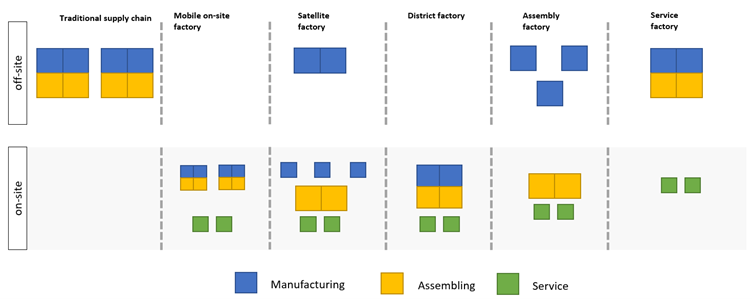
How can Europe renovate faster, more sustainably, and with less disruption? In BuildUPspeed, one promising answer is the Pop-Up Factory (PuF): a flexible, local production or assembly setup that brings industrialized renovation closer to where it is needed. Rather than relying only on fragmented supply chains, PuFs help organize manufacturing, assembly, logistics, and services in smarter, more local ways. Depending on the context, they can take different forms, including mobile on-site, satellite, district, assembly, and service factories. Across all types, the shared ambition is clear: reduce transport and delays, support just-in-time delivery, strengthen local value chains, and make deep renovation more scalable and efficient.
Figure 1: The scenarios of the Pop-Up Factory concept
PuFs are not a one-size-fits-all model. In BuildUPspeed, they are being shaped around the realities of five ecosystems, each with its own building stock, market maturity, supply-chain conditions, and renovation priorities. What brings them together is the effort to translate industrialized renovation into local solutions that combine speed, circularity, and practical implementation.
In Spain, the PuF concept is emerging through an Assembly Factory logic centered on maximizing off-site value creation and minimizing on-site disruption. Two completed pilots helped define this approach: in Pamplona, majority of the work was concentrated in a nearby CLT factory because site space was limited, while in Zaragoza, a temporary near-site workshop was needed to adapt and complete prefabricated timber elements when a fully factory-based approach was not feasible. Together, these cases show that the Spanish approach relies on flexible combinations of off-site assembly capacity and temporary near-site support, always aiming to keep on-site work to a minimum.
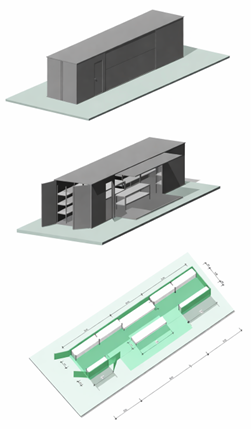
In France, the PuF is being developed as a Mobile On-site Factory focused on selective deconstruction and reuse, especially of sanitary equipment. The concept, described as a “truck for reused equipment,” is designed to link deconstruction sites directly to rehabilitation projects by enabling checking, cleaning, preparation, and reconditioning in a mobile setup. Building on pilot work in social housing, this model shows how mobile reuse operations can reduce waste, cut costs, and create new circular renovation pathways. The French case also highlights the potential social value of involving Social and Solidarity Economy actors in locally rooted reuse chains.
| Figure 2: French Ecosystem – Mobile On-Site Factory prototype |
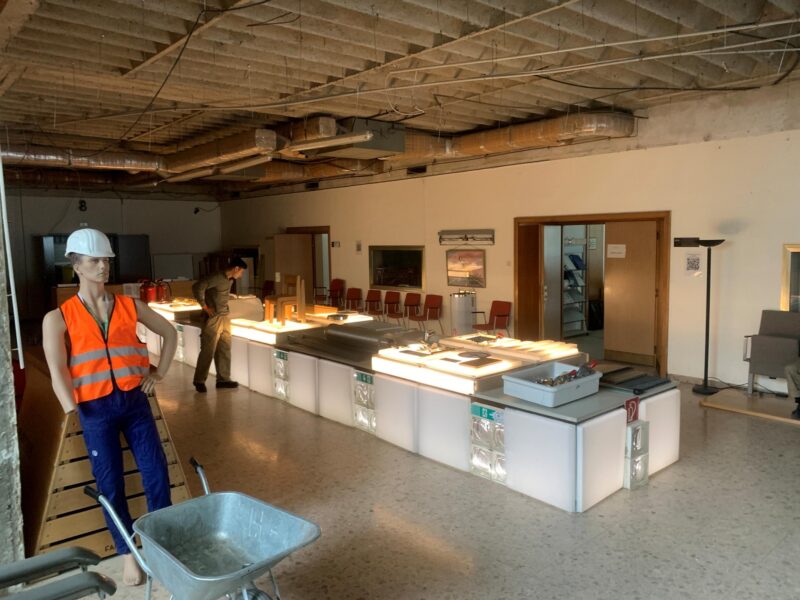
In Austria, the PuF scenario takes the form of an Assembly Factory known as the Re-Use Box, supporting a broader strategy of social urban mining. Here, the focus is on identifying, documenting, deconstructing, and redistributing reusable building components before demolition. Across shops, hotels, industrial sites, and training facilities, Austria is testing a knowledge-driven approach that combines practical dismantling pilots with tools such as a structured “screenbook” and a digital building stock documentation system. The result is a framework for embedding circularity into standard redevelopment practice while addressing challenges such as auditing, testing, warranty, and insurance.
Figure 3: Re-Use Box in Vienna 2025 (©Joanna Pianka)
In Italy, the ecosystem is exploring the pre-feasibility of a Satellite Factory model for large-scale residential renovation, especially in the public sector. While the factory itself is still under feasibility study, the concept is informed by a completed renovation pilot involving six large residential buildings, where off-site prefabricated façade elements enabled significant energy improvements while residents remained in place. This practical reference, combined with ongoing work on a hybrid factory model serving both renovation and new construction, is helping Italy assess the technical, economic, and organizational conditions needed to deploy industrialized renovation at scale.
In the Netherlands, the PuF concept is shaped by two occupied renovation pilots in Heerlen and Maastricht and points toward a district/assembly factory model. Both projects involve phased renovation under lived-in conditions, including façade upgrades, insulation, building-services improvements, and interior works. The Dutch ecosystem sees PuFs as a way to move beyond incremental renovation and toward more systemic deep-renovation delivery by bundling similar buildings into larger, repeatable packages. At the same time, the Dutch case underlines an important reality: procurement rules strongly influence how local factory ecosystems can be organized, making governance and market structure just as important as technical design.
Across BuildUPspeed, Pop-Up Factories are proving to be far more than temporary setups. They offer a new logic for renovation—one that brings production, assembly, reuse, coordination, and local value creation closer together. From reuse-driven mobile units to district, assembly, and satellite models, each ecosystem is helping define what this shift can look like in practice. Together, these experiences point to a future in which deep renovation is not only faster and more industrialized, but also more local, circular, and ready to scale.